By: Eshkar Kaidar-Heafetz
Current political discourse is reminiscent of a storm, filled with conflicting opinions over international relations, oil prices, labor rights, climate change, and artificial intelligence. However, within this cacophony is a unifying factor that Americans on all sides of the political spectrum have agreed upon: food prices. As inflation rises, families find themselves paying substantially higher prices at the register for staples such as ground beef, steak, coffee, and orange juice.
These rising costs have thus become the center of both political and social whirlpools, with electoral parties seeking to speak to the common citizen and social media becoming progressively reflective of the food crisis thousands of families across the country experience every day. Food, thus, can act as a mirror, reflective of America’s economic and political realities.
Electoral Politics – Food and Politics on the Campaign Trail
In presidential and midterm elections alike, a candidate’s position on food speaks substantially to their political stance and platform.
On the 2024 presidential campaign trail, now President Donald Trump hosted a public event in which he worked the fry station at a Pennsylvania McDonald’s, answering questions by drive-thru customers live on the news. Trump’s couple of hours of labor attempted to bring his image down to the level of the average, everyday American through rhetorical calls to the “layman’s” choice of food (i.e., McDonald’s), while intently focusing on the valuable swing state of Pennsylvania (of which he won in the coming election). This move reflected what Trump hoped to convey during his campaign, claiming that under the Biden administration, food “costs 40%, 50%, 60% more than it did just a few years ago.” The decision to use the public image of McDonald’s, a low-cost, affordable option cemented in American culture, attempted to position Trump in line with the needs of the everyday American citizen
These presidential “food tours” are incredibly common, with former President Biden famously visiting local ice-cream stores, former President Obama bonding with chef Anthony Bourdain, and even presidential candidate Kamala Harris testing the waters of a presidential run at the 2019 Iowa State Fair. Each destination and food choice is a purposeful attempt at communicating to the general public the goals, beliefs, and foundations of their political platform.
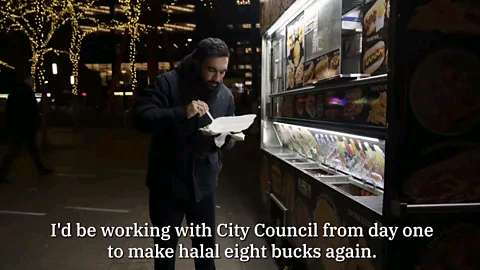
Presidential candidates are not the only politicians for whom food serves as an important center of political campaigning. In New York City, Zohran Mamdani’s successful mayoral campaign kicked off with claims of the city experiencing “halalflation,” meaning a significant rise in the cost of food from halal truck stands. Mamdani’s invocation of rising prices for a culturally relevant food item represented the core of his campaign: an attempt to speak to the immigrant populations of New York City, a demand for improved affordability, and a call against the status quo that was New York City’s incumbent mayor, Eric Adams. As opposed to mass-corporatized food, Mamdani’s campaign was reflected by his choice of overwhelmingly local, family and often immigrant-owned businesses as the center of attention for his political advertisements. Likewise, Mamdani’s position as the first Muslim mayor of New York City and his claim that “New York will remain a city of immigrants, a city built by immigrants, powered by immigrants” was shown in his hosting of Iftar dinners in City Hall this February, serving meals to Muslim residents fasting for Ramadan. This connection between Mamdani’s mayoral platform, faith, and political actions is wrapped up through the positioning of food as a conduit for political messaging reflective of who he seeks to be as a politician and a leader.
Americans’ evolving relationship to food likewise informs us of current political waves throughout the country. 2024-25’s development of the Make American Healthy Again (MAHA) movement, initially championed by President Trump and Health and Human Services Secretary Robert F. Kennedy Jr. and its adoption within the Democratic party is reflective of the rising tide of populism. MAHA’s opposition to ultra-processed foods, seed oils, pasteurization and pesticide use stems not exclusively from a scientific consensus, but progressive distrust in scientific and lawmaking structures that have long failed millions of Americans. After a period of controversial policy decisions during COVID, sustained lobbying efforts by major food and agriculture industries and a worsening economy, it is unsurprising that a discursive “populist science” has arisen in response to growing loss of faith in the institutions that shape the intimate site that is our bodies. The shift towards raw, “traditional” food, narratives of “challenging corruption” within the food industry and faith in knowledge systems stemming from the “average person” demonstrates the growing adoption of populism across both sides of the aisle, first located in decisions over the grocery aisle.
Social Media – How Food Trends are Indicative of our Economic Status Quo.
While most Americans will never find themselves chasing the votes of millions of citizens, the mass prevalence of social media provides us with a similar database to analyze current political and economic conditions in shifting food trends. As Americans prepare for shocks to grocery prices, we see variations in the kinds of foods, flavors, and preparation styles that are quiet indicators of current realities.
In a late-December New York Times article, cooking correspondent Kim Severson predicted 2026 to be a “year of quieter tastes,” contrasting 2025’s focus on luxury items such as matcha, A5 Wagyu, and mass-restaurant consumerism instead with food trends such as pickling, canning, and “value” foods such as cabbage. As prices increase and budgets shrink, Severson’s expectation for the return of such practices is a signal of declining economic conditions. The focus on hearty, inexpensive vegetables is not due to a sudden desire to shift to a more sustainable food source but rather indicative of the inability of Americans to reliably purchase staples such as meat.
At first glance, this may seem like a stretch. After all, there is always a chance cabbage is just “in”: chic, wedged, and delicious. However, investigating social media trends tells us otherwise. Throughout TikTok, Instagram, and YouTube, foodie influencers are cooking in preparation for a recession. We are watching luxury meats replaced with tinned fish, game-day dips replace chicken with beans in an attempt to cheapen the average American diet. Similarly, we are watching cultural flavors be displaced by cheap staples such as stews and soups as influencers seek to develop re-creatable meals that require tighter budgets. In fact, the sudden cultural shift towards vegetable-focused eating is not much of a “shift,” but rather a societal tug-of-war signaling economic downturn. This practice is dubbed “recession vegetarianism,” where citizens reduce the consumption of meat during periods of economic recession, later resuming consumption levels when the country’s economy stabilizes or rises once more. This mass shift indicates expected economic trends both at the level of industry and the household.
It’s likely you’ve seen it too. Every day, cheap, unassuming food items such as grilled cheese, ramen, and soups are made somewhat “more luxurious” while on a budget. The comeback of fast-casual dining, such as Chili’s, is at its height of dining for much of Gen-Z. Accessible, cheap “meal-prepping” hacks that also break down the price of individual onions, oil, rice, or other ingredients. A rise in vegetarian/vegan alternatives to many of your favorite foods, while meat-focused recipes shift to cheap poultry or canned/tinned items. Each food trend is not a singularly occurring, random event resultant of a sudden shift in everyone’s preferences, but rather is a quiet story that describes the changing, evolving economic and political conditions of America.