By: Cameron Ardoin
The European Union (EU) is one of, if not the largest, supranational institutions in the world. Its reach extends over a large swath of continental Europe and contains some of the wealthiest countries on Earth. Governing this colossal entity is a complex web of treaties, legislative bodies, and bureaucratic agencies. Some of the best-known parts of this web include the European Parliament and the Maastricht Treaty. However, there are a whole host of EU rules and bodies that receive little attention from the public. Two are the EU’s Outermost Regions and the EU’s Overseas Territories. These regions are comprised of the various territorial holdings of EU member states; however, the two categories adhere to entirely different rules and have entirely different relationships with the broader European Union. This has created a dichotomy between the two categories that has, at times, resulted in structural economic and developmental challenges for the EU overseas territories.
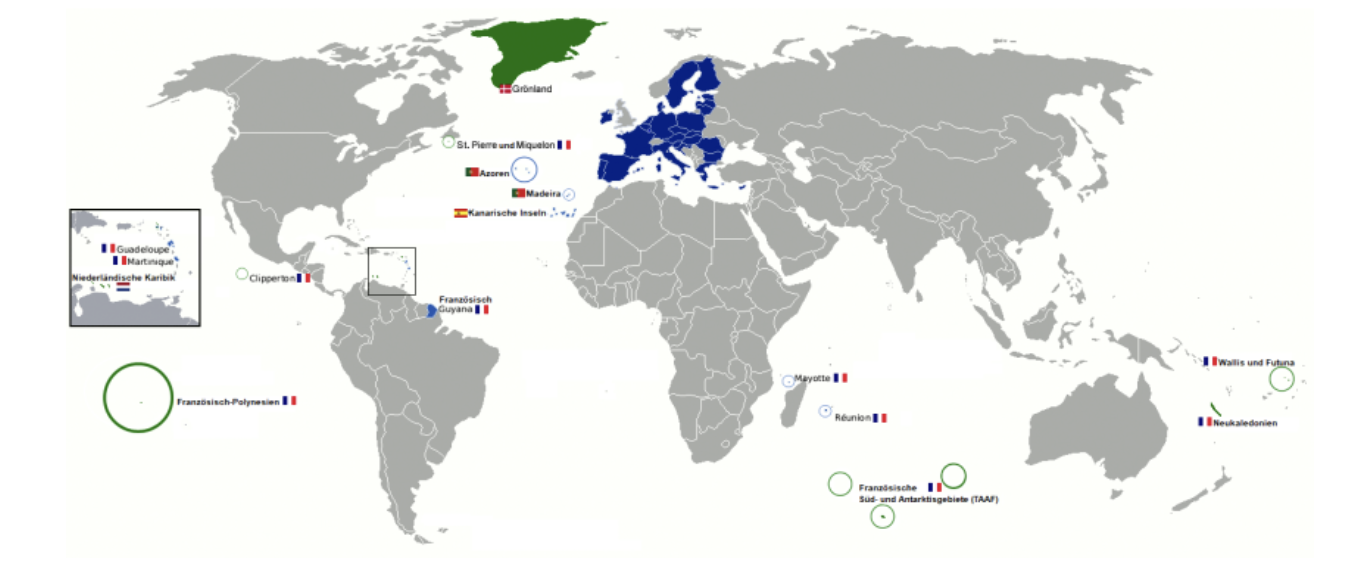
To understand why that might be, one must understand the distinction between Outermost Regions and Overseas Territories. The EU outermost regions are made up of two Portuguese, one Spanish, and three French territories. They include islands in the Caribbean Sea and the Indian Ocean, as well as the North Atlantic. These territories are considered a part of the European Union, meaning the people that live there are EU citizens and, in general, EU laws fully apply. In contrast, overseas territories, despite being held by EU member states, are not themselves part of the European Union. The Overseas Territories are made up mostly of Caribbean and Pacific islands like Curacao, Aruba, and French Polynesia; however, its most well-known member is Greenland. These territories, numbering 13 in total, are comprised of one Danish, six Dutch, and six French territories. Because they are not officially part of the EU, these territories do not receive the economic benefits of EU membership and are subject to trade restrictions typical of foreign nations. Additionally, people living in these territories do not receive EU citizenship. In fact, they are almost entirely independent of their parent country, other than in foreign relations and military affairs.
Unfortunately, the differential treatment of outermost regions and overseas territories has led to insufficient access to economic and developmental aid, particularly for the overseas territories. Because most of these territories are small island nations, they often have small populations and lack the natural resources necessary for many types of growth. Additionally, the various problems associated with climate change threaten the stability and livability of these territories. While both the outermost regions and overseas territories face these struggles, they are particularly pronounced in the overseas territories because of a lack of economic integration with their parent country. This decreases the resources and aid available to them, as well as dampening their political voices on the continent.
While some of these territories, like Greenland, have called for complete independence, others have expressed little interest in severing themselves from their parent countries. This is often due to the benefits of the military and international affairs backing of strong Western European states. In these cases, independence would likely hurt the territories more than the current situation. However, the reverse solution of bringing EU territories closer to the status of mainland areas also has significant problems. For the outermost regions, most of the current deviations from EU law are necessary given their distance from the European mainland, making it difficult to enact any changes that bring them closer into the fold. For overseas territories, desires to retain autonomy, uphold cultural values, and maintain a sense of self-determination makes forcing EU law upon them extremely controversial. This leaves lawmakers in a difficult position in which neither pushing territories to greater autonomy nor bringing them closer to the EU is an easy option.
Instead, addressing the problems faced by EU territories will likely require tailored approaches that benefit the unique situation of each place. This will likely include such measures as investment in human capital, promotion of strong local institutions, and increased trade benefits to EU territories.
In summary, despite its abundance of economic resources, the EU has allowed its various overseas territories to suffer from a variety of challenges, from climate change to poverty. These challenges are complicated by the diverse economic and social needs of each place, making overarching solutions unfeasible. While some may be perfectly happy with total independence, others rely on ties to their parent country to stay afloat. The bottom line, however, is that solutions need to be found, plans need to be made, and actions need to be taken. Otherwise, the EU’s most forgotten corners will continue to suffer from the impacts of underdevelopment and climate change.