By: Rohan Srivatsa
Once a model of democratic renewal in Latin America, Brazil now stands at a crossroads where institutions endure but the people they are meant to uphold no longer feel represented. “Ordem e Progresso,” or Order and Progress, has long captured Brazil’s dream of unity through democracy. Yet nearly forty years after the end of military rule, that dream feels increasingly out of reach. The system still operates and rights remain on paper, but the public faith that gives democracy its meaning is slowly fading. Brazil’s current crisis is not only political but also deeply social: a loss of collective trust that shows how democracy can weaken even when its formal structures remain intact.
When the dictatorship ended in 1985, democracy felt like liberation. Brazil adopted a new constitution soon after, which sought to rebuild the political and social order by guaranteeing universal suffrage and protections for civil rights after years of dictatorship. Initially a document born of optimism in self-governance, the decades that followed exposed the democracy’s weaknesses. Patronage, instability, and corruption scandals, like President Lula’s, eroded trust in political elites. As scandals unfolded, many Brazilians stopped seeing corruption as a failure of individual leaders and began to view it as proof that the entire democratic system was rigged to serve political elites. By the mid-2010s, disillusionment had hardened into division, and by the 2016 impeachment of President Dilma Rousseff, the nation split. To some, it was the legitimate removal of a mismanaged leader; to others, it was a politically motivated coup. Watching from the U.S., Larissa Lozano, a University of Georgia student who grew up in Brazil, recalls how surreal that moment felt.
“It was shocking, especially after all the support for her social programs,” she says, “It made people realize that no one, not even the president, was safe from politics.”
That cynicism paved the way for Jair Bolsonaro, whose 2018 campaign promised a return to “order” and the eradication of corruption. A former army captain, Bolsonaro appealed to a nation exhausted by scandal and stagnation. His supporters saw him as a truth-teller and restorer of discipline, while his opponents saw echoes of authoritarianism. Once in power, Bolsonaro blurred the line between democracy and strongman rule by appointing military officials to key posts, attacking journalists, and spreading doubt about Brazil’s electronic voting system.
“Bolsonaro’s rise made the right feel comfortable speaking out again,” Lozano explains, “People who were quiet before suddenly had courage. It changed how people saw themselves politically.”
She described a country divided along both ideological and economic lines. Those divisions were deeply tied to class and culture — to who benefited from Brazil’s democracy and who felt left behind.
“The PT [Workers’ Party] is very popular with lower-income families, while Bolsonaro’s base tends to be wealthier or more educated,” she says, “Brazil’s media leans left, focused on social welfare and human rights, but it also demonizes the other side, kind of like how U.S. media treats polarization.”
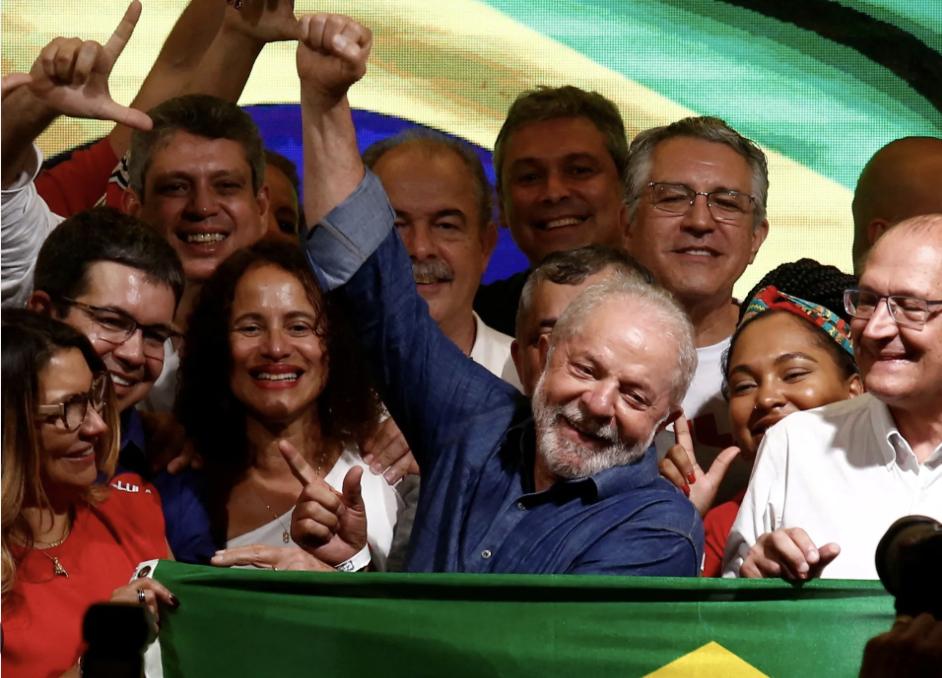
Bolsonaro’s presidency tested the resilience of Brazil’s institutions. The real rupture came in January 2023, when thousands of his supporters stormed government buildings in Brasília, refusing to accept his defeat to Lula da Silva. The rioters waved flags and demanded military intervention, a chilling reminder of the dictatorship Brazil once fought to overcome. The military stayed out, and the judiciary acted swiftly, but the episode confirmed that faith in democracy had fractured.
According to Freedom House’s 2024 Report, Brazil remains “Free,” meaning that citizens still enjoy core political rights and civil liberties, but its score has declined due to rising polarization, disinformation, and attacks on journalists. A Latinobarómetro survey found that fewer than one in three Brazilians are satisfied with democracy — among the lowest rates in Latin America. This data supports what Larissa describes: distrust in the system has seeped into daily life. The problem is not that the system has failed, but that people have stopped believing it can succeed.
“Most people don’t trust elections anymore,” Larissa says, “There’s a lot of suspicion about electronic voting, and no mail-in ballots, so people feel powerless to challenge the results.”
Across Brazil, political discussion has retreated from classrooms, dinner tables, and even social media, where civic debate has given way to misinformation and outrage.
“Politics has become entertainment,” Larissa explains, “Corruption is so normal now that people don’t even get angry — it’s just accepted.”
For younger generations, issues like education, crime, healthcare, and infrastructure dominate discussions, yet few believe those problems will ever truly be solved. Brazil’s experience is not isolated. Across the world, democracies are facing similar pressures from populist leaders who exploit public frustration to consolidate power. While Hungarian Prime Minister Viktor Orbán dismantled checks and balances under the banner of “illiberal democracy,” and Turkish President Recep Tayyip Erdoğan used religion and nationalism to erode judicial independence, Bolsonaro’s Brazil followed the same script, claiming to defend democracy while steadily undermining its foundations.
Despite backlash, threats, and limited resources, teachers, independent journalists, and community organizers in Brazil continue to promote civic engagement, expose corruption, and fight for safer, fairer neighborhoods.
“Bolsonaro’s presidency, for all its controversy, did one thing right,” Lozano reflects, “It forced people to pay attention. Everyone started talking about politics again.”
She believes that renewed awareness, however chaotic, might be the first step toward reform. Her outlook captures the paradox at the heart of Brazil’s democracy: a country where institutions endure, yet citizens feel increasingly detached from them. The Carnegie Endowment for International Peace calls this “autocratization through consent,” in which citizens tolerate illiberalism out of frustration with democratic dysfunction. In Brazil, it looks like resignation; a quiet withdrawal rather than rebellion. “Order and Progress” remains emblazoned on the flag, but its meaning is contested. Order without accountability risks repression; progress without trust risks collapse. Brazil’s democracy endures not through unshakable faith, but through the persistence of those who, despite doubt, still show up — to teach, to vote, to speak, to hope. The question is whether that endurance will be enough.