By: Aishwarya Yaddanapudi
“This is a shared world with a common future and that my kind like yours have the right to live in it” (X-Men 97)
Since the release of James Gunn’s Superman (2025), comic books have taken the world by storm. The movie has been called a “breath of fresh air” by critics and “hopeful for the future” by audiences. Beyond giving people hope and relatability in hard times, these heroes have grown politically important. Superman (2025), for example, put a spotlight onto current issues like immigration. The movie’s recognition of current issues sparked debate about politics in movies. But have superheroes always been political?
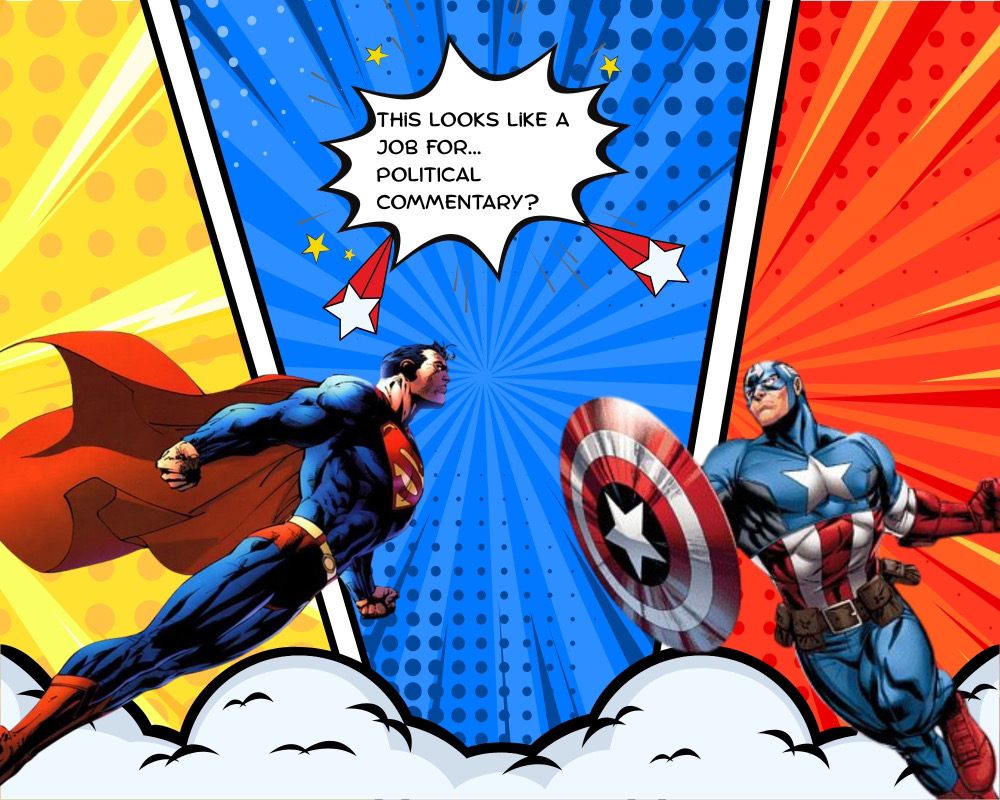
During and after World War II, comic books entered their most influential era, commonly known as the “Golden Age.” By 1943, “around 35% of adults between 18 and 30 regularly read at least six comic books per month.” Many of the world’s favorite superheroes, such as Captain America, come from political backgrounds. Captain America’s story begins with Steve Rogers, who is from a poor immigrant family. He then gets recruited for the Super Soldier program, which turns him into Captain America. The creators of Captain America, Joe Simon and Jack Kirby, were Jewish themselves and designed the first issue of Captain America’s cover to be the superhero “punching Adolf Hitler in the face.” This comic book cover and Captain America’s character as a whole was largely inspired by the creators’ lives and the sentiments of their fellow Americans during World War II. Superman followed a similar trajectory. Created by Jerry Siegel and Joe Shuster, both sons of Jewish immigrants, Superman was envisioned as a symbol of resilience during the Great Depression. Early comics framed him as a “street hero” fighting corruption, greed, and inequality, which mirrored the creators’ frustration with economic and social instability. In the comics, both superheroes can be seen acting in tandem with certain values and reflecting those values throughout various political events.
Comic books did not just remain on paper, though, as Marvel comic books started being sold at higher demand. Spearheaded by Stan Lee, who created iconic characters like Spider-Man and the X-Men, Marvel transformed comic book storytelling into a multi-billion dollar film franchise. The Marvel Cinematic Universe (MCU) has since grossed over $30 billion worldwide, demonstrating the genre’s unmatched cultural influence. One core feature of the comics remained intact: their political edge. A key example is the X-Men, a group of humans born with genetic mutations that gave them superpowers. They were often seen as “different” or a “threat,” with the main conflict focusing on whether mutants were dangerous or should be weaponized by the government. Stan Lee utilized racial and homophobic undertones throughout the comic book series that was translated to the movies as well. In addition to relevant social issues being clearly portrayed in these movies, there are also depictions of historical events that shape the heroes, such as the Holocaust, the Cuban Missile Crisis, and JFK’s assassination. This ties into the real world by making the political commentary accurately reflect how these events affected people’s lives at the time. James Gunn’s Superman (2025) also serves as a modern example. James Gunn explains that Superman (2025) is rooted in the classic American Dream. The story follows a man who comes from another place in search of a better life. Gunn addresses the fact that “it’s about politics,” and he adds that “it’s really about [Lois and Superman’s] relationship and the way different opinions on basic moral beliefs can tear two people apart.”Moreover, the government has long influenced the creation and portrayal of heroes in comic books. During World War II, political cartoons and propaganda spread globally, with Captain America issues often featuring military messaging. Through Steve Rogers, the government promoted recruitment among young men to serve in the war, just as Captain America did. In recent years, James Gunn’s Superman (2025) sparked controversy, with outlets like Fox News saying that audiences “don’t go to the theater to be lectured” and arguing that Superman (2025) should avoid addressing modern political issues such as immigration and international conflict. But superheroes have always been political. From Detective Comics (DC) to the MCU, superhero stories have addressed oppressive regimes and ideologies that harm people. Superheroes embody the belief that everyone deserves protection under the same laws. Equality under a single majority is not true equality, and in these stories, superheroes strive to create a safer, more inclusive world. They exist to help people feel seen and to give a voice to the voiceless. If the government listens, there may be a chance for the kind of change superheroes have always represented.