By: Colin Lemaistre
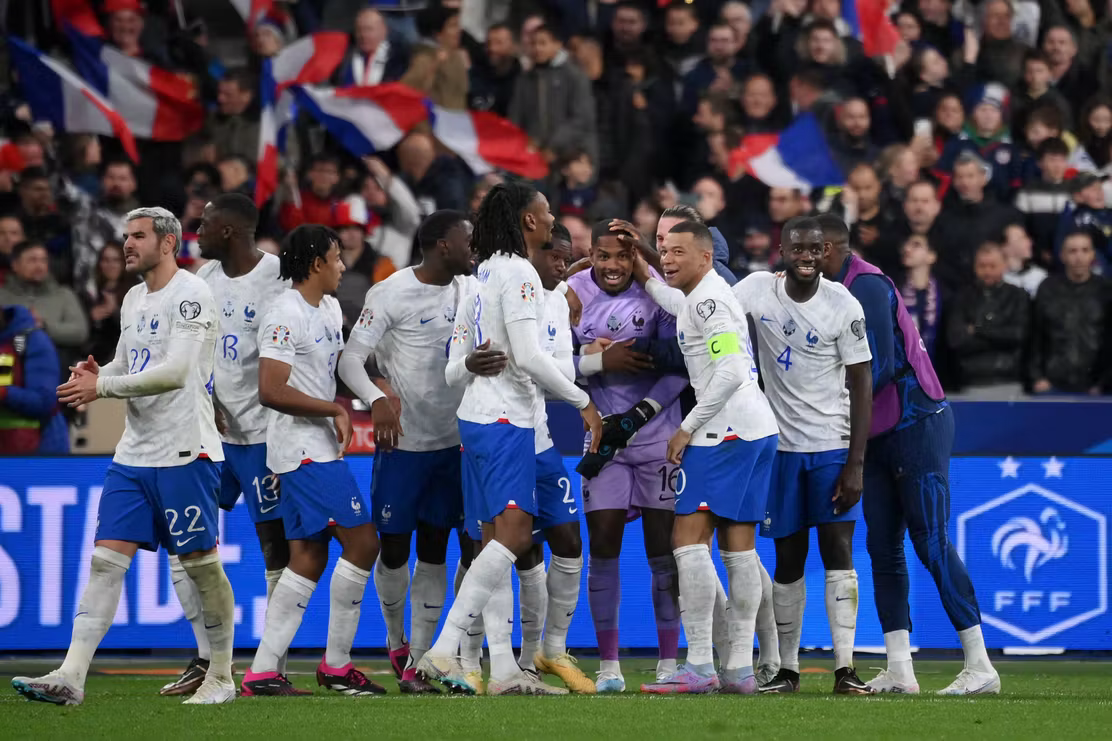
The French national soccer team, Les Bleus, exists as a living paradox. Over the last 30 years, France has been arguably the most successful footballing nation on earth, clinching the 1998 World Cup, the 2018 World Cup, and coming within a penalty shootout of a third title in 2022 against Argentina. Yet, for every trophy hoisted, a deeper, more fractured conversation about national identity emerges. At the heart of the debate is a statistic that remains a point of pride for some and a source of contention for others: in the 2022 World Cup squad, 19 of the 25 players were of immigrant descent, with heritage tracing back to countries like Algeria, Cameroon, Mali, and the Democratic Republic of Congo. As we approach the 2026 World Cup, the question remains: Why is the team that brings France its greatest glory also the one that exposes its deepest social divides?
The year 1998 was supposed to be the “Year Zero” for a new, inclusive France. After defeating Brazil 3-0 in the final, the nation rallied around the slogan “Black, Blanc, Beur” (Black, White, and Arab). Led by Zinedine Zidane, a son of Algerian immigrants, the team was hailed as the ultimate proof that the French Republic’s “universalist” model, where everyone is a citizen regardless of race or religion, was working. However, historians now view that period of tranquility in 1998 as a brief truce, and not a permanent change. Even as millions celebrated on the Champs-Élysées, far-right leader Jean-Marie Le Pen was labeling the team “artificial,” claiming it was “unnatural” to have so many players who didn’t look like his version of “traditional” Frenchmen.
The fragility of this national pride became evident in 2010 during the “Knysna scandal,” or “the mutiny of Les Bleus” where players went on strike at the World Cup in South Africa. Critics immediately framed the rebellion as a “failure of integration,” not a sporting failure, specifically for a lack of patriotism. They blamed players from the banlieues, Parisian suburbs commonly known to be representative of crime-ridden housing projects for disadvantaged communities. Recently, the 2022 World Cup final against Argentina triggered a wave of racial abuse directed at players like Kingsley Coman and Aurélien Tchouaméni after they missed penalties. Even Kylian Mbappé, the modern face of French football, has been a target of racism. After Euro 2021, he famously considered quitting the national team because he felt the French Football Federation failed to protect him from racial slurs. “I cannot play for people who think I’m a monkey,” Mbappé said in an interview with Sports Illustrated, powerfully demonstrating the conditional nature of French acceptance: you are “French” when you win, and an “immigrant” when you lose.
France is often at the forefront of this resistance because of its unique political philosophy: Universalism. Unlike the United Kingdom or the United States, which recognize “multiculturalism” and hyphenated identities (such as African-American), the French state only officially recognizes “citizens.” It is actually illegal for the French government to collect census data on race or ethnicity. This creates a disconnect: the soccer team is a visible, multi-ethnic reality that the state’s official ideology tries to ignore. When the team succeeds, it’s a victory for the Republic, but when it fails, the “immigrant” labels are used to explain the lack of “French values” like discipline or loyalty. France’s specific colonial history with North and West Africa adds a layer of tension that other European nations don’t feel as acutely. For many on the French right, the team represents a “Great Replacement” of their idea of French society, fueling fears that traditional French identity is being erased.
While France is the primary target for these critiques, it is hardly alone in its demographic makeup. In the 2022 World Cup, 14 of 26 players on Morocco’s national team were born outside the country (mainly in France, the Netherlands, and Belgium). In the Netherlands, The Dutch squad has long featured players of Surinamese descent, and in Spain, players like Lamine Yamal (Equatoguinean/Moroccan descent) and Nico Williams (Ghanaian descent) have become the faces of the Spanish national team. The difference is that in France, the national team is often the only place where diversity is so visible. In other sectors of French society, such as the National Assembly or corporate boardrooms, people of immigrant descent remain significantly underrepresented.