By: Anya Biswas
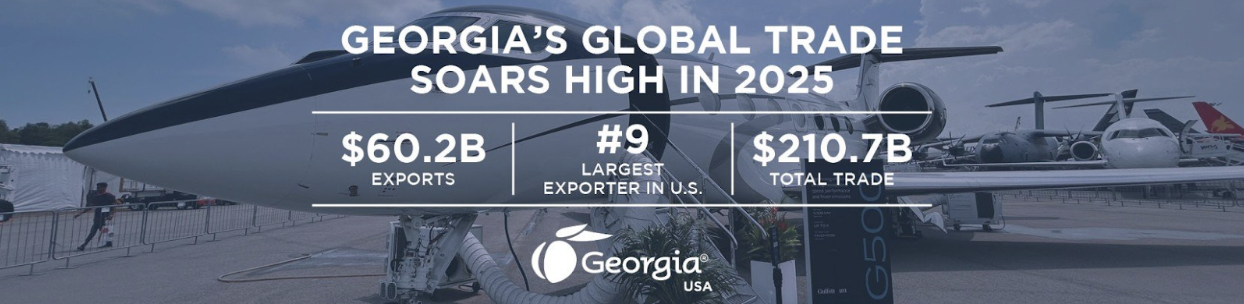
From Jimmy Carter to Coca Cola, Georgia is widely internationally recognized for institutions such as CNN, UPS, the Atlanta airport, and Home Depot, but many are not aware of the Georgia Department of Economic Development (GDEcD) International Offices located worldwide: Argentina, Brazil, Canada, Chile, Colombia, Europe, Israel, Japan, Korea, Mexico, Peru, Southeast Asia and the United Kingdom and Ireland. The GDEcD facilitates international trades, attracts foreign investment, and strengthens state-level international relations.
Gov. Brian Kemp and Commissioner Pat Wilson frequently go on trade missions, intertwining business and diplomacy by meeting with companies and representatives abroad. Most recently, they visited Belgium and the United Kingdom in February 2026. They also host delegates and company executives for trade talks, for example, the Belgian delegation with Princess Astrid of Belgium visited Georgia in June 2022. The top five exports from Georgia in 2025 were civilian aircraft parts, computers and hardware, motor vehicles, network communications equipment, and medical devices. Many large international companies are located in Georgia, including Hapag-Lloyd, Hyundai Motor Group, KIA Motors, La Regina Atlantica, Mercedes-Benz USA, Porsche USA, Q CELLS, SK On, TEKLAS, and more.
In addition to trade and investments, these international offices play an essential role in maintaining and fostering the partnerships between these countries, regions, and cities. Atlanta alone partners with 17 sister cities, including Brussels, Nuremberg, Tbilisi, Lagos, Rio de Janeiro, Toulouse, and more. In 1967, former Mayor Ivan Allen Jr. forged Atlanta’s first sister city relationship with Salzburg, Austria.
One major indication of a bilateral partnership is through educational opportunities at the universities in Georgia. The University of Georgia, Georgia Institute of Technology, and Emory University, along with other colleges, coordinate study abroad programs across the world, notably with the UGA Campus in Cortona, Italy, and the GT Europe campus in Metz, France. Athens, GA, and Cortona are sister cities, and more than 8,000 UGA students have attended the program, while more than 13,000 students have attended the GT Europe campus since its founding in 1990. Atlanta has over 70 consular or trade offices and over 30 chambers of commerce. These cultural and trade connections go further than official statements through the exchange of information and culture via cultural events, exchange students, trained employees, and a high number of tourists. The booming film industry in Georgia also attracts global attention, along with showcasing international movies at the Rome Film Festival.
Due to the interest from a high number of expats in the major Atlanta metropolitan area, the International School of Atlanta opened its doors in 1984 and offers diplomats and other international families International Baccalaureate programs in multiple languages. Atlanta also has various Saturday schools as well as churches where services are held in French, German, Korean, Mandarin, and other languages that complement the need for a linguistically diverse workforce. These cultural connections are equally important when attracting businesses and working internationally because they create a long-term personal connection that can only be established through state-to-state relationships. When working with companies, it is beneficial for them to have an accessible point of contact, someone who understands their culture and business concerns.
Looking to the future in Georgia, there are several industries that are booming, including several defense companies that are located in Georgia. Data centers and Artificial Intelligence are becoming increasingly important topics, especially considering Georgia’s attractive energy prices. The automotive industry has been one of the major sectors in Georgia. There have been several changes within the industry, with the push for and then the pullback of electric vehicles while balancing the continued demand for combustion vehicles. Georgia has invested in renewable energy and sustainability research, but its companies still mainly produce traditional cars and vehicles. It is challenging for the US and international companies to keep up with the prices and technology in China, which are some of the most competitive in the field. There are several initiatives to increase robotics and automation in Georgia, such as RoboGeorgia and the Institute for Robotics and Intelligent Machines (IRIM) at GT. These programs aim to increase automation by helping companies connect with suppliers, technology, and information to advance competitiveness.
With several changes in the United States tariff policy, international companies are concerned that the uncertainty about trade relations will negatively impact their earnings reports. Hyundai has invested billions into Georgia and opened many job opportunities across the state. However, in September 2025, Immigration and Customs Enforcement (ICE) officers arrested approximately 475 people from the Hyundai plant in Georgia. There was a significant backlash from South Korean officials advocating for the rights of their citizens. This event fractured the relationship between Korea and the United States, causing tension over the safety of international workers in the US and the relationship between Seoul and Washington, D.C., threatening Georgia’s over fifty years of close relations with Korea. In spite of the changing political and trade situations, many companies are still interested in expanding to Georgia because of the right-to-work policies that make it easier for the manufacturers to manage their local workforce, highlighting the importance of maintaining strong trade, investment, and diplomatic ties between Georgia and international partners who are interested in continuing the long-standing partnerships and benefit from the US market.